Politics and change in the Middle East by Roy R. Andersen
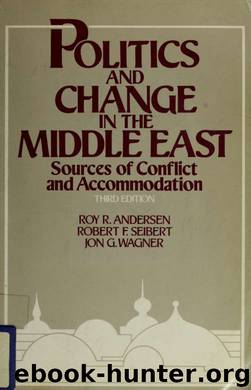
Author:Roy R. Andersen
Language: eng
Format: epub
Tags: Middle East -- History.
Publisher: Prentice-Hall International
Published: 1990-10-25T16:00:00+00:00
year. Now suppose that the price of imported oil increased and the United States continued to import the same number of barrels. More dollars were flowing out of the United States, and less were being spent by U.S. consumers on U.S. goods. Now suppose that the exporting country spent all of those earned dollars on U.S. goods. With the same total amount of money being spent on the same total amount of goods, the straightforward result is that the oil producer had more goods and the United States had less. The only way out of this situation was to eliminate spending on imports by conserving energy and developing internal sources.
The U.S. government, however, failed to respond with a clearly defined program. Attempts to develop comprehensive energy programs floundered throughout the decade. Instead, individual actors, aided by a pliant government, attempted to recoup their losses by spending more. In terms of our simple scenario, they pumped more money into the system. More money chasing the same amount of goods results in inflation. And inflation meant that members of OPEC could purchase less with each "petrodollar" earned. OPEC, therefore, raised prices in order to recoup its position. The 1970s inflation in the United States was not caused primarily by OPEC actions; rather, continued U.S. inflation virtually guaranteed further rounds of OPEC price increases. Since the United States remained the most powerful economy in the industrialized world, it transmitted these problems to other countries.
Although the situation was far more complicated than the foregoing description suggests—especially important were the complications that arose from the exporting countries not spending all of the petrodollars they earned—it represents the nub of the issue. The members of OPEC had control of a large enough percentage of world petroleum supplies to call the tune. They had become a full-fledged cartel that controlled the supply in the supply-demand equations. Most petroleum companies clearly understood these shifting power relationships by the late 1960s. At least one went so far as to launch an advertising campaign calling for a more sympathetic view of the Arab cause. Others sent similar messages to official Washington. They knew that they were engaged in a rearguard action and were attempting to forestall the inevitable. The U.S. public had another point of view. Most people saw the situation as resulting from a U.S. government blunder or from oil company actions. Conspiracy theories abounded. It was as if the public could not quite believe that a group of Third World countries could have the power to foment such disorder and then "get away with it." Indeed, it was the first time that a group of Third World countries had secured such a position.
The Third World countries that had begun to industrialize but had no oil could not fully share in the jubilation. Instead, they suffered. They were not economically strong enough to adopt the Western attitude of considering the price increases to be an unfortunate irritant that caused problems but nevertheless could be lived with. The major Arab members of OPEC responded to the plight of the poorer countries by stepping up their aid programs.
Download
This site does not store any files on its server. We only index and link to content provided by other sites. Please contact the content providers to delete copyright contents if any and email us, we'll remove relevant links or contents immediately.
| Arms Control | Diplomacy |
| Security | Trades & Tariffs |
| Treaties | African |
| Asian | Australian & Oceanian |
| Canadian | Caribbean & Latin American |
| European | Middle Eastern |
| Russian & Former Soviet Union |
The Secret History by Donna Tartt(18974)
The Social Justice Warrior Handbook by Lisa De Pasquale(12172)
Thirteen Reasons Why by Jay Asher(8858)
This Is How You Lose Her by Junot Diaz(6845)
Weapons of Math Destruction by Cathy O'Neil(6231)
Zero to One by Peter Thiel(5743)
Beartown by Fredrik Backman(5691)
The Myth of the Strong Leader by Archie Brown(5474)
The Fire Next Time by James Baldwin(5398)
How Democracies Die by Steven Levitsky & Daniel Ziblatt(5185)
Promise Me, Dad by Joe Biden(5120)
Stone's Rules by Roger Stone(5060)
A Higher Loyalty: Truth, Lies, and Leadership by James Comey(4923)
100 Deadly Skills by Clint Emerson(4888)
Rise and Kill First by Ronen Bergman(4747)
Secrecy World by Jake Bernstein(4712)
The David Icke Guide to the Global Conspiracy (and how to end it) by David Icke(4664)
The Farm by Tom Rob Smith(4475)
The Doomsday Machine by Daniel Ellsberg(4463)
